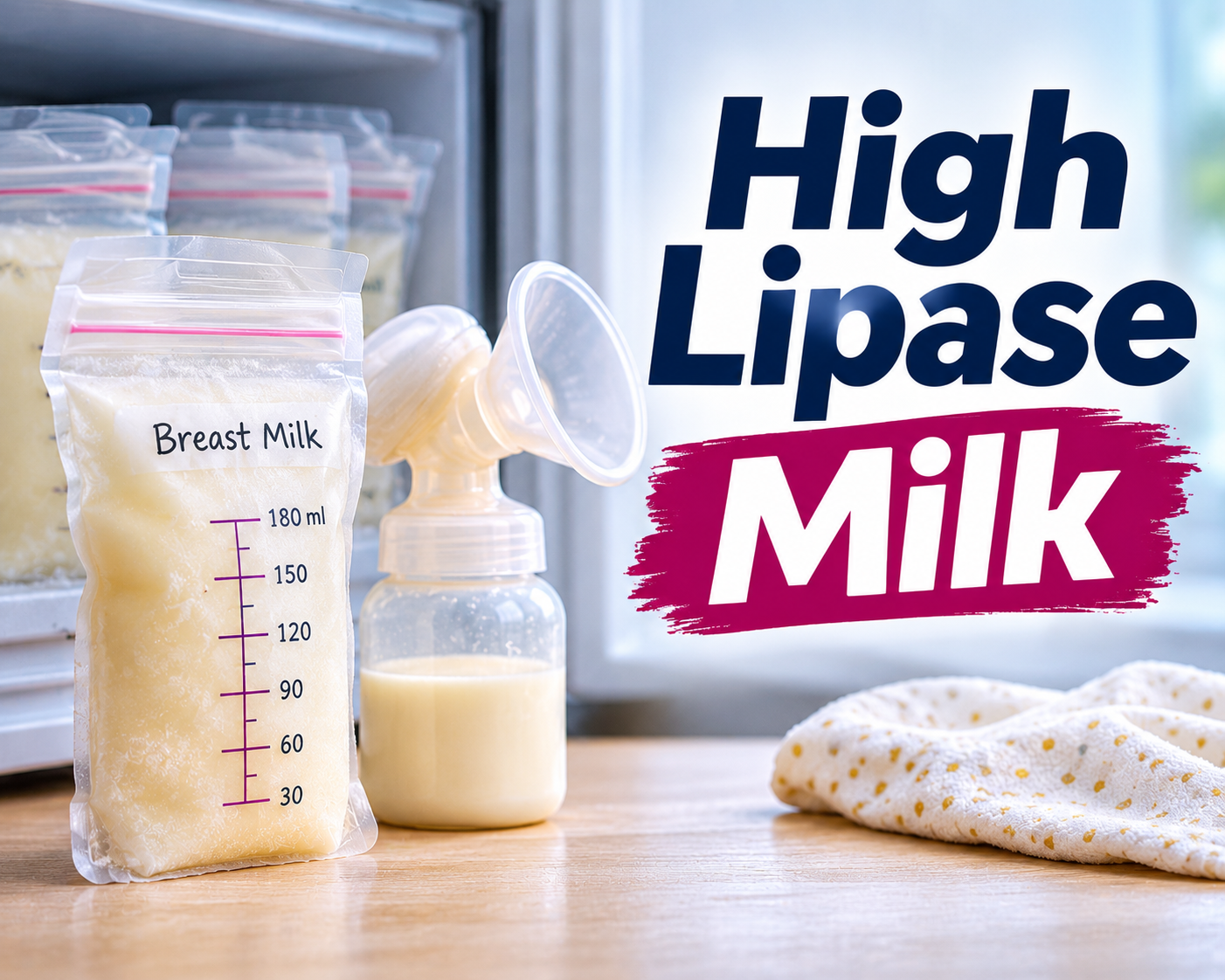
A storage-troubleshooting guide for soapy, metallic, or rancid-smelling expressed milk, baby refusal, and safer next steps
The term high lipase milk is often used when freshly expressed breast milk smells normal but becomes soapy, metallic, or rancid-smelling after refrigeration or freezing. Lipase is a normal milk enzyme that helps break down fat. During storage, fat breakdown and oxidation can change aroma and flavor even when milk has been handled correctly.
The label can be misleading. A 2019 study of frozen milk that babies had refused did not find unusually high lipase activity. Smell changes can involve normal enzymes, fat breakdown, oxidation, or several processes together rather than simply “too much lipase.”
High Lipase Milk at a Glance
| What you notice | What it may mean | Is it automatically unsafe? | Best next step |
| Fresh milk smells normal, stored milk becomes soapy or metallic | Storage-related lipolysis and oxidation are possible | No, not by smell alone | Check storage timing, temperature, and whether baby accepts it |
| Baby drinks it without difficulty | Sensory change may not bother the baby | Usually compatible with use if storage rules were followed | Continue normal safe storage practices |
| Baby refuses previously accepted stored milk | Flavor or odor change may be affecting acceptability | Refusal does not prove spoilage | Try fresher stored milk and compare timing |
| Milk was left too warm or stored too long | Microbial safety becomes the priority | Possibly unsafe | Follow CDC time and temperature limits, not smell alone |
| Visible contamination, dirty container, or uncertain handling | Contamination risk | Potentially unsafe | Discard and review pump/container hygiene |
What does “high lipase” actually mean?
Lipase is naturally present in human milk and contributes to fat digestion. The Academy of Breastfeeding Medicine notes that stored milk can develop a different odor as triglycerides break down, release fatty acids, and undergo oxidation.
Soapy-smelling milk does not prove abnormally high lipase. A more accurate description is often “stored-milk flavor change” unless enzyme activity has actually been measured.
Is soapy or metallic-smelling breast milk safe for a baby?
A smell change by itself does not establish that the milk is unsafe. The Academy of Breastfeeding Medicine describes odor changes from lipolysis and oxidation without treating those changes alone as evidence of contamination.
Safety should be judged by time, temperature, hygiene, and storage history. Milk outside recommended limits should not be used simply because it smells normal, and visibly contaminated milk should be discarded.
How can you tell high-lipase-style flavor change from spoiled milk?
| Clue | Storage-related flavor change | Possible spoilage / unsafe handling |
| Timing | Fresh milk starts normal, odor changes during cold storage | Milk exceeded safe time or temperature limits |
| Odor | May become soapy, metallic, fatty, or rancid-like | Odor can be abnormal, but smell alone is not a reliable safety test |
| Container and pump hygiene | Clean, dry equipment and food-grade storage container | Dirty pump parts, wet storage container, visible debris, or uncertain handling |
| Baby response | May accept it normally or refuse because of flavor | Refusal can happen for many reasons and cannot diagnose spoilage |
| Decision rule | Use storage guidelines plus handling history | When safe handling is uncertain, discard |
How quickly can the taste or smell change?
There is no universal timeline. Some parents notice a change after a day in the refrigerator, while others notice it only after freezing and thawing. Research shows that odor-active compounds and free fatty acids can increase during storage, but the rate varies.
A simple comparison can help: refrigerate a small amount promptly and compare it fresh, after 24 hours, after 48 hours, and after freezing if needed. This does not diagnose lipase levels, but it can show when flavor changes become noticeable.
What are the current CDC breast milk storage limits?
For healthy full-term infants, CDC guidance updated in August 2026 recommends the following storage times. These limits are about safety and quality, not odor.
| Milk type | Room temperature | Refrigerator | Freezer |
| Freshly expressed | Up to 4 hours at 77°F / 25°C or colder | Up to 4 days at 40°F / 4°C | About 6 months is best; up to 12 months acceptable at 0°F / -18°C or colder |
| Previously frozen and fully thawed | Use within 1 to 2 hours after warming / room temperature | Use within 24 hours after completely thawed | Do not refreeze after complete thawing |
| Leftover from a feeding | Use within 2 hours after baby finishes feeding | Same 2-hour rule | Discard after the limit |
CDC also recommends clean food-grade containers, storage toward the back of the refrigerator or freezer, prompt freezing when milk will not be used within four days, and no microwave heating.
What can you try if your baby refuses stored milk?
Start with the least disruptive changes. Use refrigerated milk sooner, freeze it promptly when needed, and test whether your baby accepts milk stored for a shorter period.
If combining pumping sessions, cool newly expressed milk before adding it to chilled milk and base the storage deadline on the oldest milk. For babies already eating solids, feeding choices should match developmental stage and pediatric guidance.
Should you scald breast milk to stop the flavor change?
Scalding is commonly suggested because heat reduces lipase activity. However, the Academy of Breastfeeding Medicine advises against heating milk above 40°C solely to deactivate lipase because heat can reduce immunologically active factors.
Scalding should therefore not be the automatic first-line solution. If shorter storage does not solve persistent refusal, discuss options with an IBCLC, pediatrician, or breastfeeding-medicine clinician, especially for premature or medically fragile infants.
Does freezing make high-lipase milk worse?
Freezing can increase sensory changes because lipolysis and oxidation products can accumulate during storage. This does not make properly stored frozen milk unsafe, but it may explain why a baby accepts fresh milk and rejects older frozen milk.
If flavor is the main problem, test smaller freezer batches and shorter storage intervals before building a large stash.
Frequently Asked Questions About High Lipase Milk
Is high lipase milk bad for my baby?
A storage-related soapy or metallic odor does not by itself mean the milk is harmful. If the milk was expressed, stored, thawed, and served within safe guidelines, many babies drink it without difficulty.
Why does my breast milk smell fine fresh but strange after a day?
Storage allows milk enzymes and oxidation processes to change fats and odor-active compounds. The timing varies between people and storage conditions.
Does high lipase mean something is wrong with my diet?
Not necessarily. Lipase is a normal milk enzyme, and stored-milk odor changes are not considered proof of a dietary problem. Oxidation and storage conditions can also affect aroma.
Can I freeze milk immediately to stop the soapy taste?
Freezing promptly may slow some changes compared with prolonged refrigeration, but it does not stop all enzyme or oxidation activity. Test a small frozen sample before building a large stash.
Can I mix fresh milk with high-lipase stored milk?
CDC advises cooling freshly expressed milk before combining it with already chilled milk. Use the storage date of the oldest milk. Whether mixing improves flavor acceptance varies by baby.
Does a metallic or rancid smell mean the milk is spoiled?
Not automatically. Stored human milk can develop metallic, soapy, or rancid-like notes through fat breakdown and oxidation. Safety still depends on storage time, temperature, hygiene, and handling.
Should I scald every batch before freezing?
Not routinely. Heating can inactivate enzymes but can also reduce beneficial bioactive components. Because the Academy of Breastfeeding Medicine advises against heating above 40°C solely to deactivate lipase, get individualized lactation guidance before making scalding a regular practice.
What if my baby suddenly refuses all stored breast milk?
Compare fresh milk with milk stored for shorter and longer periods, review pump and container hygiene, and confirm storage temperatures. If refusal continues or feeding intake drops, contact the baby’s pediatrician or an IBCLC.
Bottom Line
“High lipase milk” is a useful everyday label, but the biology is more complicated than simply having too much lipase. Normal enzymes, fat breakdown, oxidation, time, and temperature can all change flavor.
If your baby accepts safely stored milk, odor change alone is not a reason to discard it. If the baby refuses it, try shorter storage times first. Treat scalding as a tradeoff rather than a default fix and seek lactation or pediatric guidance when problems persist.